


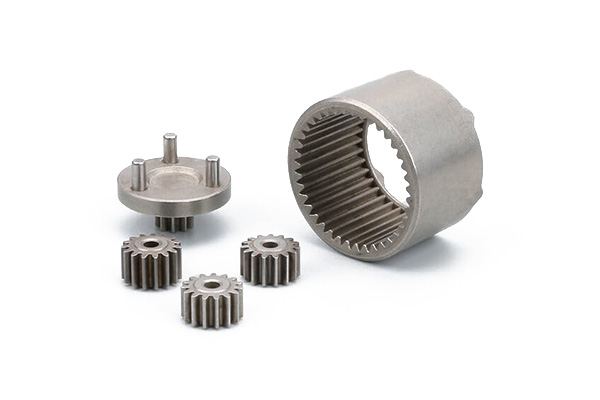
Part Size: 1-150 mm
Weight: 0.1-300 g
Tolerance: ±0.3%
Surface Finish: Ra 0.8–1.6 um
Materials: SS316L, 17-4PH, SS420, Ti Alloy etc
Density: ≥96–99% Wrought
Secondary Operations: CNC, Polishing, Laser Marking

Industry Expertise

Factory Price

OEM/ODM Services
A planetary gear system shows its mechanical excellence by transmitting power through multiple paths at once. This engineering marvel achieves 97% efficiency per stage, making it perfect for high-torque applications.
A planetary transmission gear is a high-performance gear transmission system where the input shaft and output shaft are coaxial. It is not a single gear, but a compact and complete transmission system, often referred to as a planetary gearbox. Unlike traditional parallel shaft gears, its power is shared by multiple sets of meshing teeth simultaneously.
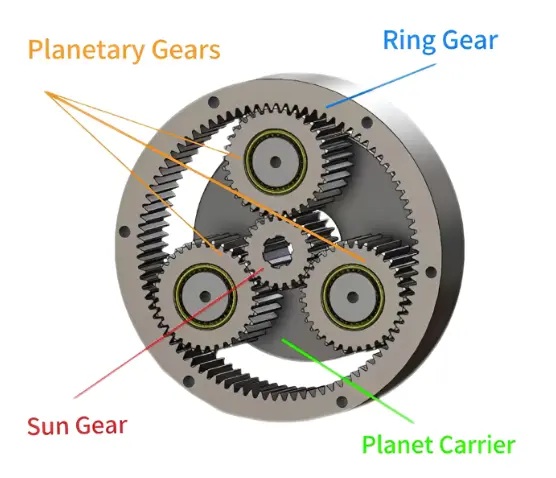
4 Core Components in planetary system
Ring Gear:
The outermost annular component with teeth on the inner side, which can be fixed or used as an input or output end.
Sun Gear:
The gear located at the exact center of the planetary transmission gear, generally used as an input end or fixed end to drive the planetary gears to rotate.
Planetary Gears:
Evenly distributed around the sun gear, meshing with both the sun gear and the ring gear, rotating on their own axes while revolving around the sun gear.
Planet Carrier:
A component used to install and support the planetary gears, usually serving as the output end to transmit torque and power.
Key system components are developed according to customer drawings, CAD files, material requirements, tolerance requirements, surface finish needs and production volume. Customization must be reviewed together with MIM manufacturability, tooling feasibility, shrinkage behavior and inspection strategy.
Types of planetary transmission gear
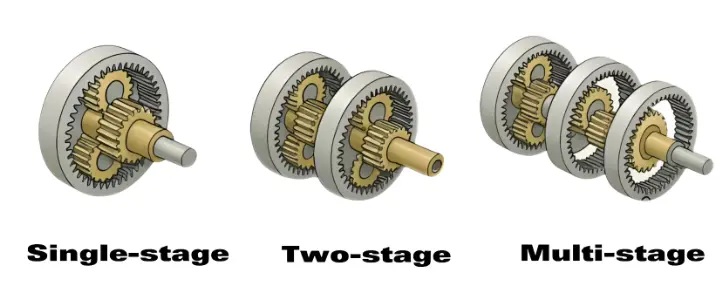
Planetary transmission gears can be divided into different types according to different classification criteria. The following are the three most commonly used types classified by “number of transmission stages”:
Single-stage planetary gear
A single-stage planetary transmission consists of only one set of planetary gear trains, including one ring gear, one sun gear, planetary gears and a planet carrier.
-Speed ratio is usually 3-10
-Only one transmission stage, few parts and compact structure
-High transmission efficiency
Two-stage planetary gear
A two-stage planetary transmission is formed by connecting two sets of single-stage planetary gear trains in series, taking the output of the previous stage as the input of the next stage to achieve a larger reduction ratio.
-Speed ratio is usually 10-50
-Two-stage planetary mechanism in series, slightly longer in axial direction than a single-stage planetary gear
-Torque is significantly higher than that of a single-stage
Multi-stage planetary gear
A multi-stage planetary transmission is composed of multiple sets of planetary gear trains in series, with an extremely large speed ratio. The most commonly used in industry is the three-stage.
-Speed ratio is usually 50-200
-Multi-stage planetary mechanism in series, but the overall size is still smaller than that of ordinary gearboxes
-Multi-tooth bearing, extremely strong load capacity
Key Advantages of Planetary Transmission Gear:
1. Small size and compact structure
Under the same power and torque, it is smaller and lighter than ordinary gearboxes.
2.Large load capacity and high torque
Multiple gears bear force at the same time, which can bear a larger load and transmit higher torque.
3.Wide speed ratio range
It can be designed as single-stage, two-stage or multi-stage according to different needs, and the speed ratio can be selected from small to large.
4.High transmission efficiency
It can reduce friction and heat generation, with less power loss and high efficiency.
5.Stable operation and low noise
Uniform force, small vibration and relatively quiet operation.
6.Good rigidity and long service life
Durable, not easy to break, suitable for long-term continuous work.
FAQ:
Why choose MIM for planetary gears?
MIM can economically manufacture intricate planetary gear components with high precision.
When should I choose MIM instead of CNC machining or stamping?
Choose MIM when the part is small, metal, geometrically complex and needed in repeat production volume. CNC may be better for low-volume prototypes or highly localized precision features. Stamping may be better for flat sheet-metal parts. MIM becomes more attractive when the part has 3D features, holes, hooks, bosses, pivots and compact functional geometry that would be costly to machine or stamp.
Industrial machinery and automation systems require durable mechanical components capable of operating under c...
View More
The consumer electronics industry requires small, lightweight, and highly precise metal components. MIM techno...
View More
The automotive industry requires precision metal components that meet strict performance and durability standa...
View MoreBack to Top
