Industry news
By: Jetvision
Aug 19,2026
Metal Injection Molding (MIM) is a manufacturing process used to produce small, complex metal components in medium to high production volumes. By combining fine metal powders with injection molding technology, MIM can produce intricate geometries that may be difficult or costly to manufacture using conventional machining or other metal forming processes.
MIM is widely used for precision components in industries such as hardware, security, consumer electronics, industrial equipment, tools, and mechanical systems.
For OEM engineers and purchasing teams, understanding how MIM works and when it is suitable can help determine whether it is the right manufacturing process for a specific metal component.
What Is Metal Injection Molding?
Metal Injection Molding is a powder-based manufacturing technology that uses a feedstock consisting of fine metal powder and a polymer-based binder system.
The feedstock is injected into a mold in a similar way to plastic injection molding. After molding, the binder is gradually removed, and the molded component is sintered at a controlled temperature.
During sintering, the metal particles bond together and the component shrinks to achieve its final dimensions and density.
The basic MIM process can be summarized as:
Metal Powder → Feedstock → Injection Molding → Debinding → Sintering → Secondary Operations → Inspection
This process allows manufacturers to produce complex metal components in large quantities with consistent geometry.
How Does the MIM Process Work?
1. Feedstock Preparation
Fine metal powder is mixed with a carefully controlled binder system to create MIM feedstock.
The feedstock must have suitable flow and molding characteristics so that the metal powder can fill the mold cavity consistently.
Common MIM materials include stainless steels, low-alloy steels, tool steels, and other alloys suitable for the process.
2. Injection Molding
The feedstock is heated and injected into a precision mold under controlled conditions.
At this stage, the component is called a green part.
The green part has the same basic geometry as the final component but contains a significant amount of binder and is intentionally larger than the final sintered part.
3. Debinding
The binder system is gradually removed from the molded component.
Depending on the feedstock and production process, debinding may involve thermal, solvent, catalytic, or combined methods.
The goal is to remove the binder while maintaining the structural integrity of the component.
4. Sintering
After debinding, the component is heated in a controlled atmosphere furnace.
During sintering, the metal particles bond together and the component undergoes controlled shrinkage.
This stage is critical for achieving the required density, mechanical properties, and dimensional consistency.
5. Secondary Operations
Depending on the application, additional processes may be required after sintering.
These can include:
· Heat treatment · CNC machining · Grinding · Polishing · Tumbling · Plating · PVD coating · Passivation
A well-designed MIM component can minimize the need for secondary machining.
What Types of Parts Are Suitable for MIM?
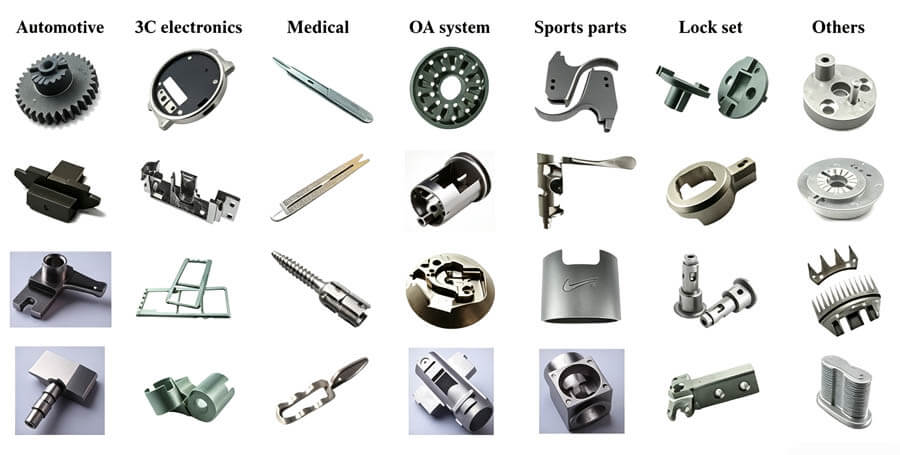
MIM is particularly suitable for components with a combination of small size, complex geometry, and medium to high production volume.
Typical MIM applications include:
Lock & Security Components
· Lock cylinder components · Padlock components · Smart lock parts · Access control components · Key system components
Mechanical Components
· Levers · Cams · Brackets · Housings · Actuator components · Small structural parts
Gears & Transmission Components
· Spur gears · Planetary gear components · Small transmission parts · Gearbox components
Hardware & Tool Components
· Fastening components · Tool holder parts · Hand tool components · Power tool components · Cutting tool components
Consumer Electronics Components
· Watch components · Mobile device components · Camera components · Wearable device parts · Small appliance components
The suitability of MIM should always be evaluated based on the actual part drawing, material, annual volume, and dimensional requirements.
What Are the Main Advantages of MIM?
Complex Geometry
One of the biggest advantages of MIM is its ability to produce complex three-dimensional geometries.
Features such as holes, slots, curves, ribs, steps, and other intricate details can potentially be incorporated directly into the molded component.
High Production Efficiency
Once the tooling and process have been validated, MIM can produce large quantities of consistent components.
This makes it particularly attractive for OEM applications with stable designs and recurring production demand.
Reduced Machining
Many features can be formed during injection molding rather than machined individually.
This can reduce machining time, material waste, and the number of manufacturing operations.
Excellent Material Utilization
Compared with subtractive machining, MIM forms the component close to its final geometry, which can significantly reduce material removal.
This can be particularly valuable when using relatively expensive alloys.
Good Dimensional Consistency
With properly designed tooling and controlled processing conditions, MIM can provide consistent dimensions across large production batches.
What Are the Limitations of MIM?
MIM is not the best solution for every metal component.
Higher Initial Tooling Investment
Dedicated injection molds are required for production, so MIM usually involves a higher initial tooling investment than CNC machining.
Production Volume Matters
For prototypes or very small quantities, tooling costs may make MIM less economical.
MIM generally becomes more attractive as production volume increases.
Part Size Is Limited
MIM is primarily used for relatively small components. Large or heavy metal parts may be better suited to CNC machining, forging, casting, or conventional powder metallurgy.
Design Must Consider Sintering
MIM components shrink during sintering. Therefore, tooling and process design must account for material-specific shrinkage and potential dimensional variation.
MIM vs Conventional Powder Metallurgy
MIM and conventional Powder Metallurgy (PM) are both powder-based manufacturing technologies, but they are not the same process.
Conventional PM typically uses pressing and sintering, while MIM uses injection molding followed by debinding and sintering.
Conventional PM is generally more suitable for relatively simple geometries that can be effectively compacted in a die.
MIM provides greater freedom for complex three-dimensional shapes and intricate features.
In simple terms:
Simple geometry + high volume → Conventional PM may be suitable
Complex geometry + high volume → MIM may be suitable
The actual choice depends on the part design and production requirements.
MIM vs CNC Machining
CNC machining removes material from a solid workpiece to produce the required geometry.
It is highly flexible and is often suitable for prototypes, low-volume production, large components, and designs that are still changing.
MIM requires dedicated tooling but can become highly competitive for small, complex components produced in medium to high volumes.
For this reason, many OEMs use CNC machining during prototype development and consider MIM when production volumes increase and the product design becomes stable.
What Materials Are Used for MIM?
Common MIM material families include:
· 304L stainless steel · 316L stainless steel · 17-4 PH stainless steel · 420 stainless steel · 440C stainless steel
· Low-alloy steels · Tool steels · Titanium alloys · Other specialty alloys
The best material depends on the application's requirements for strength, hardness, corrosion resistance, wear resistance, magnetic properties, surface finish, and cost.
Material selection should be confirmed before tooling begins because material choice can affect processing behavior, shrinkage, heat treatment, and final properties.
How Much Do MIM Parts Cost?
MIM part cost depends on several factors, including:
· Part weight · Geometry complexity · Material · Production volume · Tooling complexity
· Tolerances · Secondary operations · Surface treatment · Inspection requirements
MIM typically involves higher initial tooling costs than CNC machining, but the per-part cost can become highly competitive at larger production volumes.
Therefore, MIM should be evaluated based on total production cost, rather than tooling cost or unit price alone.
When Should You Consider MIM?
MIM is worth considering when your component has several of the following characteristics:
· Small or compact size
· Complex geometry
· Medium to high annual volume
· Multiple machining operations
· Stable product design
· Consistent dimensional requirements
· Suitable metal material
· High material utilization requirements
If a component is simple and requires only a few hundred pieces, conventional PM or CNC machining may be more appropriate.
If a component is small, complex, and produced in large quantities, MIM may provide a significant manufacturing advantage.
Metal Injection Molding is a powerful manufacturing technology for producing small, complex precision metal components at medium to high production volumes.
Its ability to combine complex geometry, material efficiency, production consistency, and reduced machining makes it an attractive solution for many OEM applications.
However, successful MIM production starts with the right part design, material selection, tooling strategy, and production volume.
If you have a 2D drawing or 3D model, an experienced MIM supplier can evaluate the geometry and determine whether MIM is technically and economically suitable for your application.
Have a metal component you are currently machining, casting, or forming? Send us your drawing and annual quantity for a preliminary MIM manufacturing review.
Back to Top