Industry news
By: Jetvision
Nov 13,2026
For manufacturers producing small, intricate metal components, CNC machining has long been a common manufacturing solution. However, complex geometries - including internal undercuts, cross-drilled holes, fine splines, thin walls and contoured internal features - often require multiple machining setups, custom fixtures, frequent tool changes and extensive material removal. These additional operations increase production time, tooling costs and the risk of dimensional variation, particularly when working with hard-to-machine materials such as stainless steel and other specialty alloys.
Metal Injection Molding (MIM), a near-net-shape manufacturing process, offers an effective alternative for producing many of these complex components. By forming intricate features directly during the molding stage, MIM can significantly reduce downstream machining requirements while maintaining consistent part quality in medium- to high-volume production.
Unlike conventional CNC machining, which removes material from solid bar or billet stock to create the required geometry, MIM forms components by injecting a mixture of fine metal powder and polymer binder into a precision-designed mold cavity. The molded parts then undergo debinding and high-temperature sintering, during which the binder is removed and the metal particles bond together to form a dense metal component. Controlled shrinkage during sintering brings the part to its final dimensions, with dimensional accuracy depending on material characteristics, component geometry and process control.
This near-net-shape approach allows many geometric features to be incorporated directly into the mold, reducing the need for separate drilling, milling and other machining operations.
Forming Complex Geometries Directly in the Mold
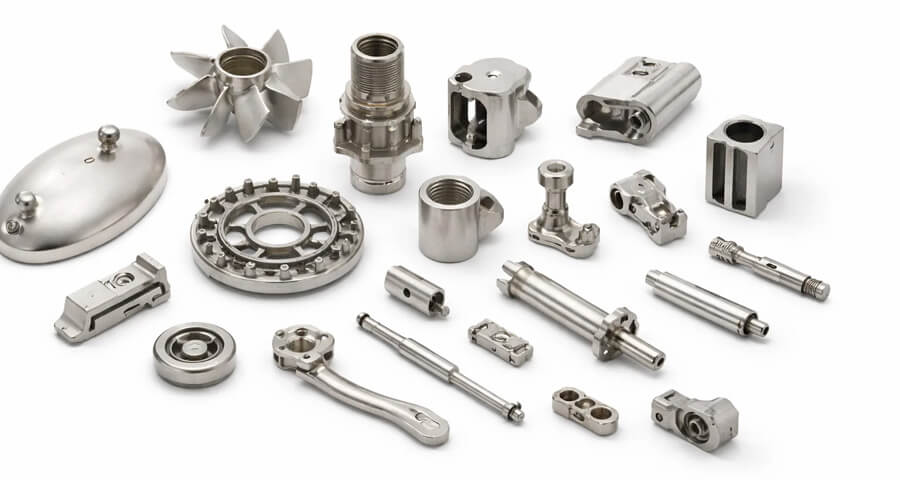
One of the main advantages of MIM is its ability to produce intricate geometries that would otherwise require multiple CNC machining operations. Features such as through holes, blind holes, grooves, serrations, fine surface details and certain internal threads can be incorporated into the mold design, depending on their geometry and tooling requirements.
Internal undercuts and complex profiles can also be produced using specialized mold structures, including side actions and movable core mechanisms. This reduces the need for additional machining access, custom fixtures or separate EDM operations.
MIM is also suitable for manufacturing components with thin walls and intricate transitions, where conventional machining may introduce problems such as tool deflection, vibration and material deformation. By forming these features during injection molding, manufacturers can reduce the amount of secondary processing required.
Reducing Material Removal and Machining Waste
Material utilization is another important factor in reducing overall manufacturing costs.
In conventional CNC machining, complex components are often produced by removing substantial amounts of material from oversized metal stock. Depending on the part geometry, a significant proportion of the original material may become machining chips, increasing raw material consumption and machining time.
MIM uses metal powder more efficiently by forming components close to their final geometry. Excess feedstock from gates and runners can often be recovered and reused under controlled production procedures, helping improve material utilization.
Because MIM components require less material removal after sintering, manufacturers can also reduce machining allowances and shorten finishing operations. In many applications, only critical sealing surfaces, precision bores, mating faces or other functional areas require additional grinding, honing or CNC machining. Most other geometric features can be produced during the molding process.
Fewer Machining Operations and Lower Production Risk
Every additional machining operation introduces potential sources of manufacturing variation. Repeated workpiece positioning, fixture alignment, tool wear, broken taps and drilling errors can all affect dimensional consistency and production efficiency.
By integrating more features into the molded geometry, MIM reduces the number of machining setups and handling steps required to complete a component. This can simplify production workflows, reduce operator intervention and improve manufacturing consistency across large production batches.
These benefits are particularly valuable for small precision components with complex structures, where multiple machining operations can account for a substantial portion of the total manufacturing cost.
For stainless steel MIM parts and other specialty metal components, reducing secondary cutting operations can also help limit tool consumption and machining difficulties associated with abrasive materials or work-hardening behavior.
When Is Secondary CNC Machining Still Necessary?
Although MIM can significantly reduce machining requirements, it does not eliminate the need for secondary machining in every application.
Some components require extremely tight dimensional tolerances, highly precise bore finishes or specific surface conditions that cannot be achieved directly through conventional MIM production. In these cases, selective CNC machining, grinding or honing may still be necessary to meet functional requirements.
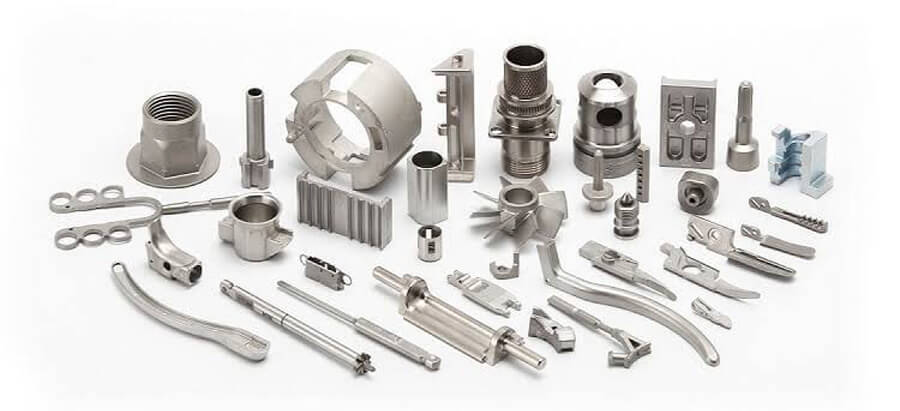
The most effective approach is often a combination of MIM and secondary finishing. Complex external profiles, grooves, integrated features and other intricate geometries are formed during molding, while machining is reserved for critical dimensions and functional surfaces.
This hybrid manufacturing strategy allows manufacturers to retain the geometric advantages of MIM without compromising the precision requirements of the finished component.
MIM vs. CNC Machining: Production Volume and Cost Considerations
MIM is generally most competitive for small-to-medium-sized components with complex geometries and medium-to-high production volumes. Although precision mold manufacturing requires an initial tooling investment, the cost can be distributed across a large number of parts during continuous production.
CNC machining, on the other hand, offers greater flexibility for prototypes, customized components and low-volume orders because it does not require dedicated injection molds.
When evaluating whether to convert a machined component to MIM, manufacturers should consider several factors:
·Part geometry: Components with multiple intricate features and difficult-to-access surfaces may benefit more from MIM.
·Production volume: Higher production quantities help offset initial mold investment and reduce per-part manufacturing costs.
·Material requirements: The selected metal powder and sintering process must meet the required mechanical and application-specific performance.
·Dimensional tolerances: Critical dimensions should be identified early to determine whether secondary machining is necessary.
·Part design: Design for MIM (DFM) can help optimize wall thickness, feature geometry, powder flow and mold configuration.
Early collaboration between product designers and MIM manufacturers is essential to identify opportunities for reducing machining operations while maintaining component functionality.
As manufacturers continue to seek more efficient ways to produce complex precision metal components, Metal Injection Molding provides an effective solution for reducing dependence on conventional CNC machining.
By transferring geometric complexity from machining operations into precision mold design, MIM can reduce material waste, shorten production workflows and minimize the number of secondary operations required. For suitable small and intricate metal parts, this approach offers an effective balance between manufacturing efficiency, dimensional consistency and production cost.
For OEM manufacturers evaluating complex machined components, MIM is worth considering as an alternative or complementary manufacturing process, particularly when production volume and part geometry make near-net-shape manufacturing economically attractive.
Back to Top